
Municipalities are under constant pressure to deliver complex capital projects and programs on time and on budget. However, cost overruns and schedule delays remain persistent across the country, with 75 percent of capital project owners exceeding their original budgets and 77 percent reporting that their projects were delivered late.
Over time, these overruns lead to financial losses, reputational damage, missed strategic objectives and negative public perception. While these outcomes are often attributed to execution challenges, they are typically the result of project performance issues that go undetected until they are too advanced to mitigate effectively. A key contributing factor is the lack of real-time, objective visibility into capital project performance.
What are project controls?
Project controls are the systems and processes used to measure project performance against approved plans, identify deviations early and inform corrective action. They are widely used in complex capital projects across various sectors, where they bring greater clarity, predictability and control to project delivery. At their core, capital project controls are anchored in monitoring four critical dimensions of project health: scope, schedule, cost and risk. Together, they create a reliable, data-driven view of overall project health.
For municipalities, this capability is essential. Capital projects are funded by taxpayers, subject to public accountability and tied to long-term community outcomes, which leaves little room for uncertainty or delayed insight.
In practice, capital project controls act as an early warning system, continuously tracking performance to identify scope creep, schedule delays, cost overruns and emerging risks before they escalate into material issues. Most projects do not fail suddenly, but instead drift off course incrementally. Without structured monitoring, these warning signs can go unnoticed in routine reporting, meaning issues are only identified when they’re difficult or costly to address.
By identifying project issues early and providing a clear, integrated view of project performance as it progresses, project controls answer a critical question for decision-makers: are we delivering what was approved, and if not, how soon will we know?
Project management, capital project controls and the PMO
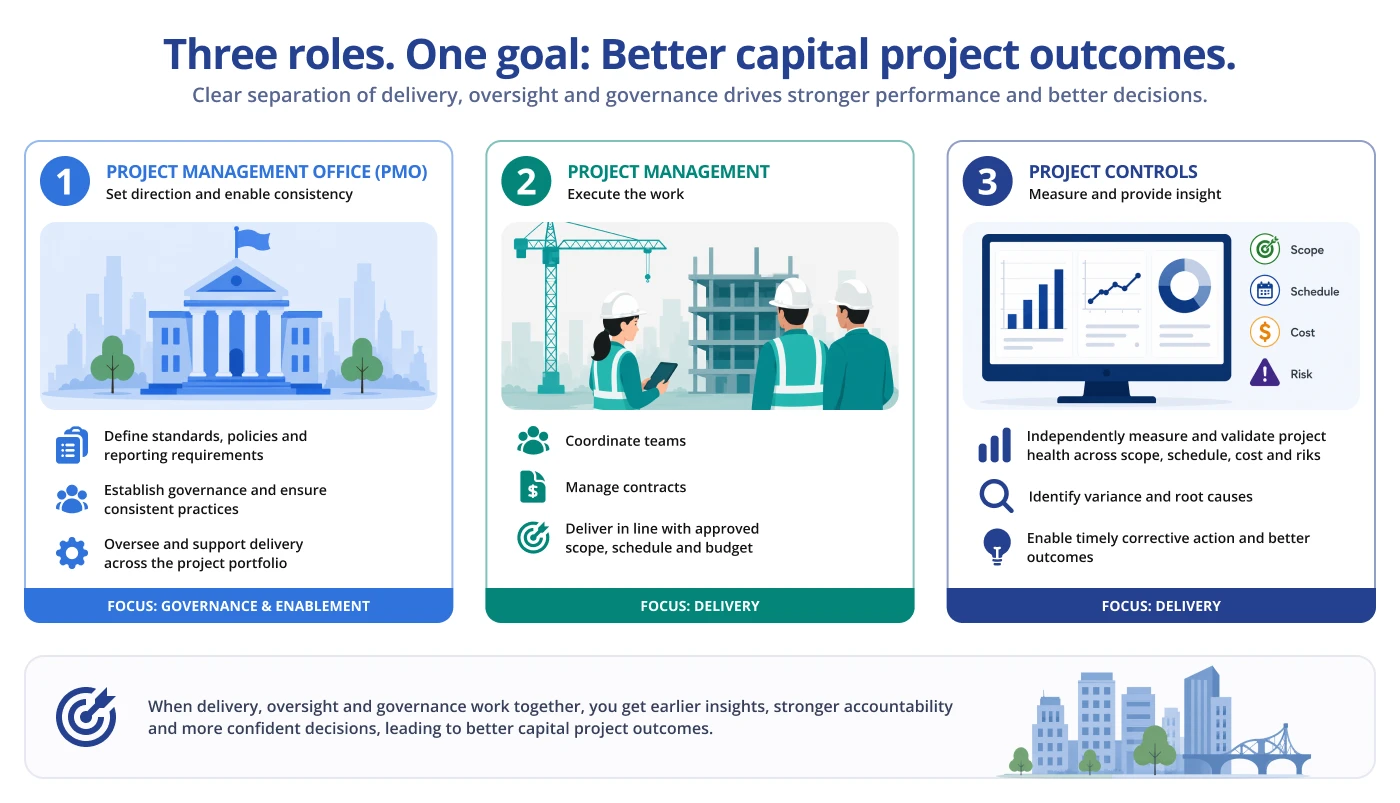
Within municipal capital programs, it is important to distinguish between project management, project controls and the Project Management Office (PMO), as each plays a distinct but complementary role in project and program governance and delivery performance.
Project managers are responsible for execution. They coordinate teams, manage contracts and ensure projects are delivered in alignment with a project’s approved scope, schedule and budget.
Project controllers provide independent measurement and validation of a project’s health by looking at its across the scope, schedule, cost and risk. Rather than executing the work, they assess whether delivery remains aligned with the approved project plan and identify where variance is occurring to enable timely corrective action and improved capital project outcomes.
Together, these functions create a clear separation between delivery and oversight:
- Project Management Teams: Execute the work and deliver project outcomes
- Project Control Teams: Measure performance, identify variance and support informed intervention
Without this separation, early indicators of performance issues can be missed, making them harder to correct later.
Within this structure, the PMO provides the overarching governance framework for complex capital project or program delivery. It defines standards, reporting requirements and consistent practices for managing projects across a portfolio of infrastructure investments.
Project controls strengthen the PMO framework by translating governance standards into measurable project performance insights. A PMO defines how a capital project or program will be managed, while project controls operate as a specialized capability, revealing how effectively projects are performing across scope, schedule, cost and risk.
This alignment shifts project controls reporting from descriptive updates to structured, data-driven insights that support earlier interventions, stronger accountability and more confident decision-making.
Capital project controls in practice
Consider a municipality working on a $100 million wastewater treatment plant upgrade. By month 14 of construction, the project appears to be on track: reported progress is approximately 45 percent, with spend at 40 percent of the approved budget and no significant change orders. At the surface, performance looks acceptable.
But project controls tell a different story. Analysis across scope, schedule, cost and risk indicates that the project is trending toward a $5 to $8 million overrun, with potential delays pushing completion into the next fiscal year. Using standard metrics, these risks would likely only surface once the project reaches 60-75 percent completion, and corrective action is more limited, disruptive and costly.
Integrated project management and PMO functions remain essential for delivery and governance. Capital project controls provide a complementary layer of objective visibility into how the project is performing against the approved plan.
This example illustrates the value of project controls as an early warning system. It enables municipalities to identify and address issues before they escalate into public, financial or operational pressure.
Benefits of project controls in municipal capital projects
The impact of capital project controls extends beyond individual projects. At the program level, project controls can help municipalities take a more consistent and disciplined approach to managing performance and risk to achieve strategic objectives.
This translates into clear, measurable value:
- Greater cost predictability, reducing the likelihood of overruns
- Improved schedule performance and forecasting, resulting in fewer delays and disruptions
- Earlier risk identification and management, reducing overall project risk
- Stronger governance and accountability, supported by consistent reporting
- Better decision-making, backed by reliable performance data
In municipal environments where funding is constrained, scrutiny is high and outcomes carry long-term implications, this level of visibility is critical to maintaining confidence in project and/or delivery.
The value is also quantifiable. Industry experience shows that effective project controls can reduce total capital costs by at least five percent, even after accounting for implementation and overhead. Given the scale of many municipal capital programs, this represents a meaningful reduction in financial exposure.
Project controls are sometimes viewed as administrative overhead. In practice, they improve the quality of information used to manage projects by strengthening, not replacing, project management. When applied consistently, project controls further reduce risk by protecting both project outcomes and public investment.
Implementing project controls in capital programs
Implementing project controls does not require a complete transformation of the existing project management framework. Rather, it entails integrating various processes, tools, methodologies and governance mechanisms. In most municipalities, this involves strengthening current practices by introducing greater consistency and proactive decision-support capabilities that enable project teams and executives to identify emerging risks early, evaluate impacts and implement corrective actions before issues escalate.
Successful implementation typically focuses on a few key elements:
- Clear performance baselines with defined scope, schedule and cost benchmarks
- Consistent monitoring and forecasting supported by reliable data and regular updates
- Defined roles and separation of responsibilities to ensure independent performance validation
- Tools, templates, process and procedures to ensure consistency project controls tasks across organization.
- Standardized performance measurement and reporting frameworks aligned across projects and programs
- Formal change management process to clearly define how changes are identified, evaluated, approved, documented and incorporated into project baselines
- Effective Data Management for improving visibility, standardization and collaboration
Rather than adding complexity, effective project controls bring visibility to project and program delivery. When applied consistently across capital projects and programs, they can enable stronger overall performance.
From visibility to confidence in controls
As municipalities continue to invest in infrastructure, expectations for project delivery will only increase. Projects are becoming larger, more complex and more visible, which further raises the stakes for timely, informed decision-making.
Project controls provide a clear advantage by providing the ability to see issues early, act decisively and maintain control over cost, schedule, scope and risk throughout delivery. In an environment where surprises carry significant financial, operational and reputational consequences, that capability is not longer optional.
For municipalities looking to strengthen their capital program performance, project controls offer a practical and proven approach to improving outcomes and increasing confidence in delivery.
To learn more about how capital project controls can be applied within municipal capital projects or programs, connect with our specialized project controls team at info@colliersproejctleaders.com.