
The essentials:
- Defining capital project needs and understanding project goals before design creates a stronger foundation for every decision that follows.
- Engaging project collaborators, including end users, operators and decision-makers, early helps uncover opportunities, build consensus and reduce potentially costly changes later.
- Infrastructure advisory services include a project planning roadmap for informed decision-making that helps project owners move from an initial vision to a design-ready project.
Every capital project begins with a vision, but successful capital project planning starts long before design. One of the first things many capital project owners do initially is look for an architect. As a registered architect myself, I understand why. Design is where ideas become tangible. It’s an exciting process that gives people something they can see and rally behind. But one of the biggest lessons I’ve learned over the course of my career is that successful capital projects rarely begin with design. They begin with questions: What problem are we trying to solve? What does our community actually need? What can we realistically afford to build and operate?
The answers shape every decision that follows. Infrastructure advisory helps project owners answer these questions, evaluate options, and build the evidence needed to move confidently from an initial idea to a construction-ready capital project.
What is infrastructure advisory?
As part of Colliers Project Leaders’ infrastructure advisory services, we offer a structured capital project planning process that helps project owners make informed decisions before design and construction. I like to think of it as a decision-making roadmap that guides project owners from their initial vision to one that’s ready to be designed, funded, procured and built.
Essentially, infrastructure advisors provide owners with the structure needed to move a project forward with confidence, whether that’s understanding community needs, defining project requirements, evaluating options, securing funding or determining the right delivery approach.
While every capital project is unique, the planning process typically follows a series of key stages, with each one building on previous decisions.
The project planning roadmap: a guide to getting your project ‘shovel-ready’
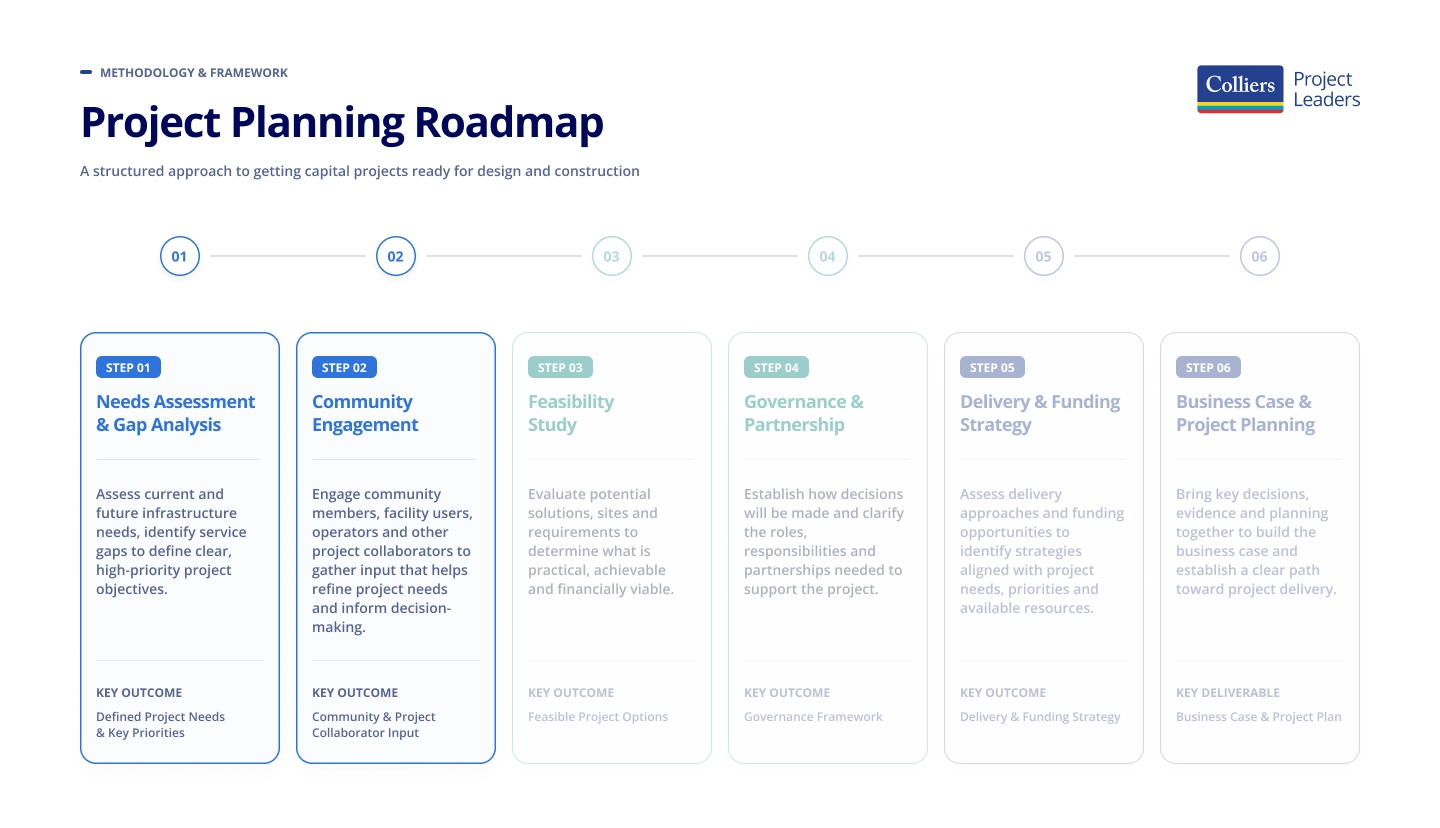
Step 1: Needs assessment and gap analysis
Before discussing project size, budget or design, project owners will want to clearly articulate the need or problem they’re trying to address. A needs assessment looks at the programs and services an organization currently provides, how well they are meeting community needs and where gaps or constraints exist. This might include looking at waitlists, available space and equipment, population and demographic trends, and how the community is expected to change over time.
That means asking questions such as:
- What programs or services are we currently providing and where?
- How well are we meeting community needs?
- Are there waitlists or other indicators of unmet demand?
- Are there constraints, such as a lack of appropriate space or equipment?
- How do we expect the community to change over the next 10 to 20 years?
- What level of service or functionality does the future facility need to provide?
The last question is particularly important because specific functional requirements can significantly influence what needs to be built, how large it needs to be and the associated costs. Is an arena intended to host large spectator events or primarily support minor hockey practices? Will a library host specific community events or share space with a community partner?
The more clearly these needs are defined, the better positioned project owners are to evaluate potential solutions and make informed decisions about scope, priorities and investments.
By combining data with community input, project owners gain a clearer understanding of how they can meet community needs. This may include building new, expanding an existing facility, renovating current assets or exploring an entirely different solution.
For example, a client may say they want a walking track. The next question is, “How long does it need to be?” It may seem like an obvious question, but that is precisely why these conversations matter.
In one case, asking that very question helped clarify that the client actually needed a 200-metre indoor track to support future competitive training, significantly changing the scope of the project. The same principle applies to other facilities, such as those housing swimming pools, where recreational use may require something very different than a facility designed to host competitive events. By understanding how communities will use the facility, project owners can better define project scope.
The objective behind a needs assessment and gap analysis isn’t simply to justify a project. It’s to ensure you’re solving the right problem before investing significant time and money into a solution.
Questions to consider:
- What challenge or need are we trying to address?
- Why is this project important now?
- Which project elements are essential and which could be adapted if needed?
Step 2: Community engagement
Once a project owner has a clearly defined understanding of the need they’re trying to address, the next step is testing and refining that understanding by listening to the people who will use, operate, support and benefit from the project.
No single group has the complete picture.
Community members can provide valuable insight into how they are using existing facilities and where service gaps exist. Staff and operators understand day-to-day operational challenges. User groups can identify functional requirements that may not be immediately obvious, while project partners and decision-makers help ensure the project aligns with broader organizational priorities.
Effective community engagement isn’t about collecting as many opinions as possible or promising that every idea will become part of the project. It’s about asking the right questions, engaging the right people at the right time, and creating opportunities for them to share their experiences, priorities and feedback. Those insights can then help project owners make more informed decisions.
Throughout the planning process, project owners should consider questions such as the following:
- Who will use this facility or service?
- Who will operate and maintain it?
- Which user groups, partners or organizations should be involved?
- How do we engage with under-represented community groups?
- How will community feedback be considered as part of the decision-making process?
Sometimes the most valuable project insights come from the people who operate a facility every day. A Zamboni operator, for example, understands that the machine needs to enter and exit the ice from the ends of the rink, due to its turning radius. It’s a seemingly small detail, but one that can influence the layout and long-term functionality of the facility if it isn’t considered early in the project planning process. It’s also a reminder that understanding what operators need can be just as important as understanding what future users want from a space.
Meaningful community engagement helps build consensus, uncover opportunities and identify potential challenges early – before they become more difficult and costly to address.
Questions to consider:
- What have we learned through community engagement?
- Are there competing priorities or perspectives to consider?
- What needs further exploration before moving forward?
From questions to solutions
Strong capital projects rarely begin with a fully-formed solution. They begin with a clear understanding of needs, the people the project is intended to serve and the outcomes it needs to achieve. A needs assessment, supported by meaningful community engagement, helps capital project owners build that understanding before making significant decisions.
Early project planning also helps owners establish priorities. Knowing which project elements are “must haves,” which are “nice to have”, and which depend on available budget can help guide decisions if budget pressures arise later. These early questions create the foundation for every stage that follows. Once capital project owners understand where they are today, where they need to go and whose perspectives must inform the journey, they are better positioned to begin evaluating potential solutions.
In the next article in this Project Planning Roadmap series, I’ll explore how feasibility studies and options analysis help capital project owners determine what is possible, practical and achievable before moving toward design.